
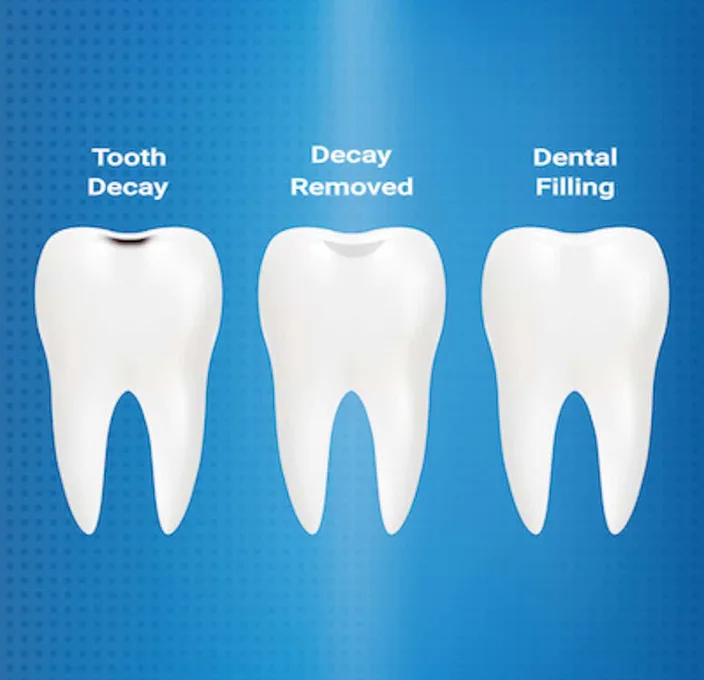
A filling repairs a tooth that has a cavity or a small chip. At Your Olathe Dentist we place tooth-colored, mercury-free composite fillings. Composite bonds right to the tooth instead of being locked in by the shape of the hole, so less healthy tooth has to be removed to hold it in place.
How a Cavity Starts
The bacteria in plaque feed on sugar and give off acid. That acid pulls minerals out of your enamel. Between meals, your saliva calms the acid down and puts some of those minerals back.
A cavity forms when the scale tips toward acid too often. That is why how often you have sugar matters more than how much. A dessert eaten in ten minutes is one acid attack, but a sweet drink sipped all afternoon keeps the attack going for hours.
In the very earliest stage, before there is an actual hole, fluoride and better cleaning can turn things around. Once the surface breaks down, though, the tooth can't heal itself and needs a filling.

Why Finding a Cavity Early Helps
Cavities don’t stay the same size. Enamel is hard, so decay moves through it slowly, but once it reaches the softer layer underneath, called dentin, it spreads much faster.
Here is how it tends to go. A small cavity needs a small filling. A bigger one needs a larger filling that leaves the tooth weaker. Bigger still, and the tooth may need a crown. If decay reaches the nerve, it may need a root canal, and if infection spreads further, an extraction.
Caught at the right time, the same tooth needs the smallest and simplest repair. That is the biggest reason we encourage regular checkups.
What Happens at Your Filling Visit
First, we numb the tooth. Then we clean out the decayed part, which is softer than healthy tooth, and shape what is left. We keep the area dry, because composite won’t bond well to a wet surface.
The composite goes on soft, like putty, and is built up in thin layers. Each layer is hardened with a special curing light. We match the shade to your tooth, shape the filling to fit the natural lines of the tooth, then check your bite by having you tap and slide your teeth, adjusting until it feels normal.
Most single fillings take less than an hour. Composite is fully set when you leave, so you don’t have to wait to eat. The numbness usually lasts a couple of hours, so be careful not to bite your cheek or tongue until it wears off.
Tooth-Colored and Silver Fillings
Tooth-colored composite is what we use. It blends in with the tooth, bonds to it so we can keep the repair small, and doesn’t need extra grooves cut in to stay put.
Silver amalgam, the metal fillings many adults got as kids, is tough and was the go-to material for a long time. If your silver fillings are still in good shape, there is usually no need to swap them out, since replacing a sound filling means removing extra healthy tooth. When one cracks, leaks, or has decay under it, that is a good time to replace it with tooth-colored material. Learn more on our metal-free dentistry page.
When a Filling Isn't Enough
A filling can only replace so much of a tooth. Once a filling covers about half of the chewing surface, it can start to act like a wedge, and the walls of the tooth around it are more likely to crack.
At that point a crown is usually the better choice, because it covers and holds the tooth together instead of pushing it apart. We'll tell you honestly when a tooth has reached that point rather than placing a filling that likely won't hold up.
Helping Your Fillings Last
Most fillings wear out at the edge, where the filling meets the tooth, because that seam is where new decay likes to start. Clean between your teeth every day, since the spots where teeth touch are exactly where a toothbrush can't reach.
If you grind your teeth, a night guard protects your fillings as well as your enamel. Call (913) 780-0011 or use our contact form.
Have It Checked Before It Grows
A cavity found early needs a simple filling. Left alone, it can turn into a crown or a root canal.